When a shaft, valve seat or roll needs a harder or more corrosion-resistant surface, three processes usually come up: laser cladding, plasma transferred arc (PTA) welding and high-velocity oxy-fuel (HVOF) spraying. They can all deposit similar alloys, but they bond to the part in very different ways.
How the layer is bonded
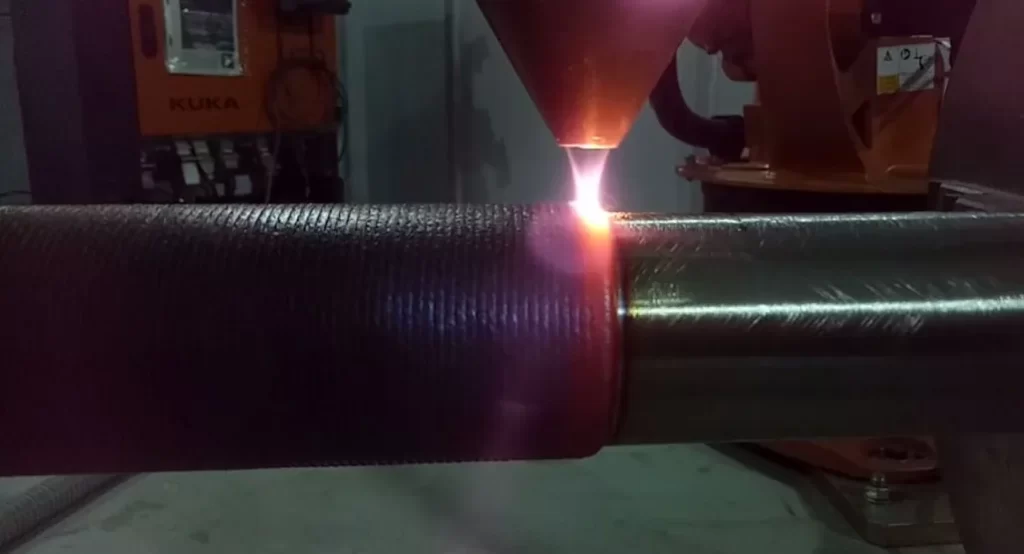
Laser cladding uses a focused laser beam to create a controlled molten pool, while metallic filler powder or filler wire is deposited to form a metallurgically bonded overlay. PTA also produces a fused, metallurgical bond, but with a broader arc and more heat. HVOF sprays particles at high speed onto the surface, giving a mechanical bond with no melting of the base metal.
Dilution and heat
Dilution is how much base metal mixes into the overlay. With laser cladding it is kept below 2%, so the deposit keeps the properties of the alloy you paid for, often in a single layer. PTA dilution is higher, so extra layers may be needed. HVOF has nil dilution because nothing is melted, but the coating is thinner and relies on its mechanical bond.
Laser cladding puts the least heat into the part of the two fusion processes. The heat-affected zone stays small and distortion is low, which matters on long shafts, thin sections and finished components.
So which one?
- Choose laser cladding when you need a fully bonded, dense layer with low dilution and low distortion, for wear, corrosion or dimensional restoration, including inside bores.
- PTA can suit thick, heavy hardfacing where heat input and distortion are less critical.
- HVOF suits thin, hard coatings on surfaces that do not see impact or need a fused bond.
Not sure which suits your part? Tell us about the component, its operating conditions and the required surface performance, and our engineers will recommend a route. See also the comparison table on our laser cladding page.